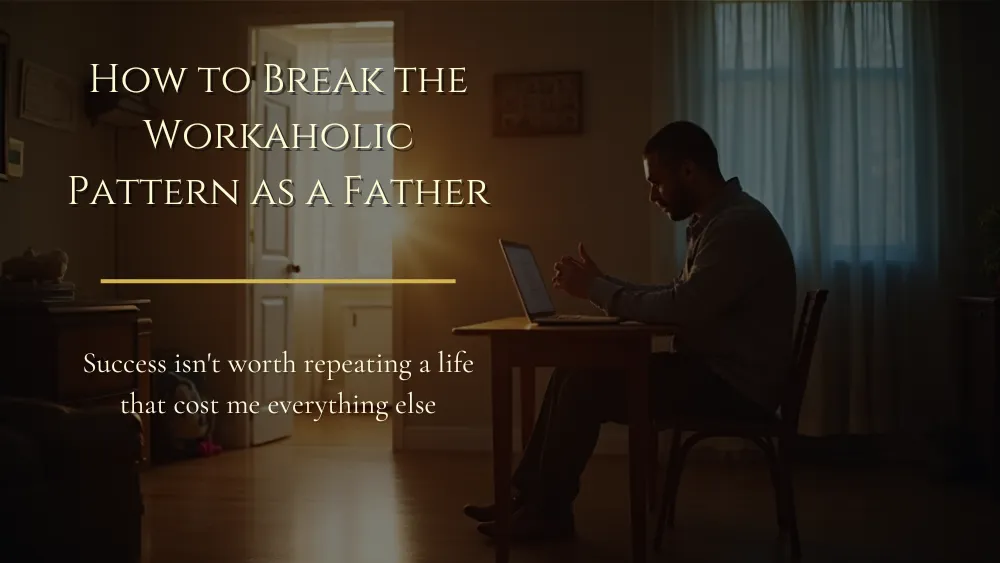
Workaholism can look like responsibility until it starts costing your family your presence. For a long time, I thought being a good provider meant pushing past exhaustion, sacrificing everything, and proving my worth through output. This chapter is about breaking that pattern before success costs me the people I am working for.
The Example That Shaped Me
I grew up in a house where work rarely seemed to stop.
My father worked extreme hours.
Relentlessly.
That was normal.
That was expected.
That was how responsibility looked to me growing up.
A man worked.
A man endured.
A man carried pressure without complaint.
A man kept going, even when there was almost nothing left of him by the time he came home.
So when I became an adult, I did the same thing.
For nearly seventeen years, I worked hours that no life should have been built around. I did not question it much at first. I did not resist it. I assumed this was simply what a good provider did.
Work was not just something I did.
It became identity.
It became proof.
It became the way I tried to measure whether I was useful, responsible, disciplined, and worthy of being taken seriously.
But somewhere along the way, I stopped asking a harder question:
What is the point of working for a life I am too exhausted to live?
When Work Becomes Identity
There is a difference between working hard and letting work become the way you prove you deserve to exist.
I did not understand that difference for a long time.
Hard work can be honorable.
Providing matters.
Responsibility matters.
Discipline matters.
Sacrifice matters.
But when work becomes identity, rest starts to feel like guilt.
Presence starts to feel inefficient.
Family time starts to feel like something I have to earn after everything else is handled.
That is dangerous.
Because everything else is never fully handled.
There is always more to do.
More to build.
More to fix.
More to chase.
More to prove.
And if I am not careful, I can spend my whole life trying to become successful enough to finally be present, only to realize presence was what my family needed all along.
That truth connects closely to How to Choose Presence Over Productivity as a Father, because fatherhood keeps reminding me that being impressive is not the same thing as being available.
My children do not need a version of me who is always chasing one more outcome.
They need a version of me who is actually there.
The Difference No One Talks About
There is another layer to this that is hard to explain.
The work I watched growing up was visible.
Physical.
Tiring in a way people could understand.
It looked like work.
It sounded like work.
It left the kind of exhaustion people respect.
My work has often looked different.
A lot of it happened behind a screen.
Long hours.
Mental strain.
Quiet frustration.
Slow results.
Invisible effort.
And because the output was not always obvious to others, it sometimes felt like people did not know whether to call it work at all.
That created a different kind of shame.
Working endlessly while still feeling unproductive.
Giving everything while still wondering if anything counted.
Trying to build something meaningful while feeling like the world only respects labor it can see immediately.
That kind of disconnect can make you push even harder.
Not only because you want success.
But because you want validation.
You want someone to finally understand that you were not wasting time.
You were trying.
You were building.
You were carrying something.
But I am learning that chasing validation through exhaustion is still a trap.
Even if the work matters.
Even if the dream is real.
Even if the mission is good.
The cost still matters.
When Hard Work Stops Making Sense
Working that much took something from me.
Not immediately.
Not all at once.
Slowly.
It took time away from my children.
It stole moments I will never get back.
It trained me to measure my worth by output instead of presence.
It made exhaustion feel normal.
It made rest feel suspicious.
It made availability feel optional when it should have been part of the point.
And one day, I realized something that stopped me cold:
Even if I succeeded, I would still be losing.
Because if success required me to become absent, depleted, emotionally unavailable, and constantly consumed by work, then what exactly was I building?
A future?
Or another version of the same pattern?
That realization hurt because I had always told myself I was doing it for the right reasons.
For my children.
For stability.
For purpose.
For a better tomorrow.
But a better tomorrow cannot be built by abandoning today completely.
That connects naturally to How Fatherhood Turns Responsibility Into Sacrifice, because fatherhood does require sacrifice. But not every sacrifice is healthy. Some sacrifices protect love. Others quietly drain it.
I had to learn the difference.
The Version of Me I Am Actively Resisting
The version of myself I am trying not to become again is not lazy.
He is not careless.
He is not irresponsible.
That is what makes him dangerous.
He looks disciplined.
He looks committed.
He looks like someone willing to do whatever it takes.
But underneath that, he equates exhaustion with virtue.
He believes rest must be earned.
He chooses productivity over presence.
He justifies absence by calling it sacrifice.
He tells himself there will be time later.
Later to be present.
Later to slow down.
Later to connect.
Later to listen.
Later to enjoy the people he says he is working for.
But later is not guaranteed.
And children do not experience love only through what we meant to do eventually.
They experience it through the version of us they receive now.
I do not want my children to remember me as someone who was always working.
I do not want them to inherit the belief that love looks like absence with good intentions.
I do not want them to think responsibility means becoming unavailable.
I do not want them to grow up believing exhaustion is the highest form of manhood.
That is the man I refuse to become again.
Choosing Presence Over Validation
I like my life better now.
Not because it is easier.
Not because it is more impressive.
Not because every financial outcome is settled.
But because it is more human.
I spend time with my children.
I hear them.
I am available.
I notice the small things.
I am not always rushing past life to prove I am doing enough.
That matters to me.
Because there was a time when I thought slowing down meant I was failing.
Now I see it differently.
Slowing down can be wisdom.
Rest can be stewardship.
Presence can be obedience.
Balance can be love.
Work-life balance is not laziness.
It is intention.
It is deciding that my family should not receive only the leftovers of me.
It is choosing not to let the world define my worth by how tired I am willing to become.
That connects with What Children Remember About Their Parents, because children may not remember every project, every late night, or every goal I chased. But they will remember whether I was emotionally reachable while they were growing.
They will remember if I listened.
If I noticed.
If I stayed.
Redefining Success Before It Redefines Me
Success no longer means repeating what I was shown.
It means breaking the pattern.
That is a different kind of achievement.
Not the kind that always looks impressive from the outside.
Not the kind that gets applause.
Not the kind that always makes sense to people who measure life only by output.
But it may be one of the most important kinds of success I ever pursue.
Because if I gain financial success but lose connection with my children, I have not won.
If I build something meaningful but become emotionally absent, I have not won.
If I provide materially but disappear relationally, I have not won.
If I prove I can survive exhaustion but lose the ability to live with peace, I have not won.
I do want to build.
I do want to succeed.
I do want my work to matter.
But I do not want ambition to cost me the very people I am working for.
That is where the line has to be drawn.
Not after the damage is done.
Before.
Learning to Let Enough Be Enough
One of the hardest lessons for me is learning to let enough be enough.
Enough effort for today.
Enough progress for today.
Enough responsibility carried for today.
Enough proving.
Enough pushing.
Enough turning work into a test of worth.
I am not always good at this.
There are still moments when old patterns call me back.
Moments when I feel behind.
Moments when pressure tells me to work longer, sleep less, and sacrifice more.
Moments when I wonder if balance is something I can afford.
But I am learning that I cannot afford the old pattern either.
It already cost too much.
And I refuse to make my children pay for it again.
That is where How Small Faithful Choices Shape Your Future fits this story. Breaking a workaholic pattern does not usually happen through one dramatic decision. It happens through repeated choices: closing the laptop, listening longer, showing up, resting, choosing presence, and trusting that the future does not have to be built through self-erasure.
What This Chapter Taught Me
Hard work can be honorable, but work should not become identity.
Providing matters, but presence matters too.
Success is not worth repeating a life that costs me connection, peace, and availability.
I am learning that rest is not laziness.
Balance is not weakness.
Presence is not wasted time.
And fatherhood is not only about what I build for my children.
It is also about whether I am there with them while they are becoming.
I do not need to prove I can survive exhaustion.
I already did.
Now I am choosing a life that allows me to stay.
Scripture Reflection
“It is vain for you to rise up early, to sit up late, to eat the bread of sorrows: for so he giveth his beloved sleep.”
— Psalm 127:2
This verse fits this chapter because it speaks directly to the lie that endless striving is always noble.
It does not condemn work.
It confronts anxious striving.
It reminds me that God does not require me to destroy myself to prove I am responsible.
He gives His beloved sleep.
That matters to me.
Because for a long time, I lived like rest had to be earned after exhaustion.
But maybe rest is not a reward for proving enough.
Maybe rest is part of trusting God with what I cannot finish today.
Continue the Story
These chapters continue the journey through fatherhood, presence, responsibility, and breaking patterns before they become someone else’s burden:
-
How to Choose Presence Over Productivity as a Father
For reflecting on why being available matters more than being impressive. -
How Fatherhood Turns Responsibility Into Sacrifice
For understanding the difference between healthy sacrifice and losing yourself in the role. -
How Small Faithful Choices Shape Your Future
For seeing how tomorrow is shaped by repeated choices that may feel small while they are happening.
Move Through This Book